


WORLD
EAST HALWORTH
The signs say 450,000. The streets tell a different story.
East Halworth sits on the eastern shore of Lake Knell, a vast body of cold, deep water whose western edge dissolves into unbroken forest and undeveloped land. The city occupies a natural bay carved into the lake's eastern face, and from that bay springs the Tarn River, a wide, turbulent waterway that bisects the city before snaking eastward toward the ocean, hundreds of miles away. Freighters move its current in both directions. So do other things, less easily documented.
The city was once something. A working port, a regional center, a place people came to rather than left. That was twenty years ago. Since then, East Halworth has been contracting quietly, shedding residents the way a building sheds plaster: gradually, then all at once. The ones who could leave did. The ones who stayed learned to live with what the city had become.
What it has become is difficult to name cleanly. Lawless is the word most often used, though it implies an absence of order rather than a replacement of it. East Halworth has order. It just doesn't come from the people paid to provide it.
The Tarn and the Middle District
The river is the city's spine, and the neighborhoods closest to it are the city's last credible claim to normalcy. The middle district along the Tarn is East Halworth at its most functional: shops still open, streets still maintained, a stretch of embankment where people walk in the evening without looking over their shoulders quite as often as they do elsewhere. The water here moves slower, the current wider and more forgiving than the turbulent sections further downriver. It is the part of the city that visitors see, if visitors come at all.
A few blocks from the river's edge, occupying what was once a six-floor office building, sits the Syndicate's compound. Walled, self-contained, converted over years into something that functions less like a building and more like a small city of its own. The residents of the surrounding blocks are aware of its existence. Nobody discusses it. The black Suburbans that move through the neighborhood are a permanent fixture of the skyline, visible enough that their presence registers as statement rather than surveillance. The Syndicate doesn't hide. It simply doesn't need to.
The North Side
The northern quarter of East Halworth is where the city's industrial past went to finish dying. Warehouses, shipping yards, and office buildings stripped of their original purposes cluster along streets that see more freight than foot traffic. Residential pockets exist but they are sparse and tend toward the threadbare, small clusters of housing pressed between loading bays and corrugated steel. The infrastructure here is functional in a provisional sense: things work until they don't, and nobody comes to fix them when they stop.
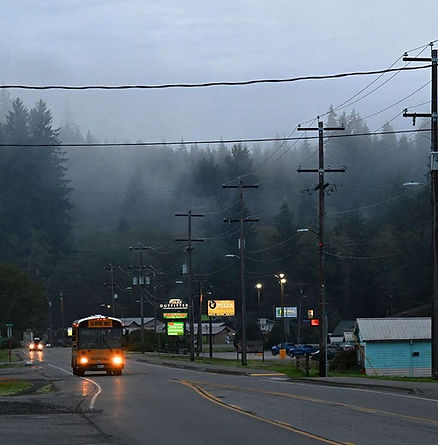
The North Side smells like diesel and standing water. On grey mornings, which is most mornings, the fog off the lake settles into the streets and doesn't lift until midday, if it lifts at all. This is where the Crimson Vipers make their home, embedded in the industrial fabric of the district, invisible to anyone not looking for them. The Iron Vultures maintain a presence here too, occupying one of the district's few residential pockets.
The Flats
The southern section of the city carries the nickname The Flats for reasons that are both geographic and atmospheric: the land here sits lower, the streets broader and less defined, the whole district spread out with a kind of resigned flatness that suits its reputation. It is run-down in the way that suggests long-term neglect rather than sudden disaster, residential streets mixed with active industrial operations in proportions that never quite resolve into either. The air tastes different here, heavier, laced with the output of the working yards.
The Black Maw operates out of The Flats, their compound embedded in the southern district with the settled permanence of something that has decided it isn't going anywhere. The Iron Vultures have a foothold here as well, one of several scattered across the city that speak to how differently they move through East Halworth compared to the organizations that hold fixed ground.
The Weather and the Light
East Halworth is a coastal city in the technical sense, though the lake rather than the ocean sets its climate. Humid and grey for most of the year, the city sees rain more often than sun and cloud more often than clear sky. Snow is rare, a function of the lake's moderating effect and the city's position relative to the mountain towns further inland, places like Sulphur Creek and Bremen that accumulate winter in ways East Halworth largely doesn't. What the city gets instead is a persistent, low-level damp: wet streets, wet air, the smell of rain on concrete that never fully dries between storms.
The grey suits it. East Halworth is not a city that photographs well in sunlight.
Law and the Absence of It
Law enforcement exists in East Halworth in the technical sense. Precincts operate, officers report for shifts, paperwork gets filed. What they do not do, in any meaningful way, is enforce the law against the organizations that have divided the city among themselves. The Syndicate's reach is too long and its presence too established for direct confrontation, and the smaller gangs that fill the city's remaining corners have learned to keep their operations quiet enough to avoid becoming useful examples. When law enforcement does move, it tends to move against the most visible and most expendable, the street-level operations with no political weight behind them.
The result is a city that functions on its own terms, with its own logic, its own hierarchy, and its own definition of consequence. East Halworth doesn't ask for much from the people who live in it. It asks only that they understand who actually runs things, and govern themselves accordingly.
Most of them learned that a long time ago.

BREMEN
Bremen sits roughly fifty miles north-east of East Halworth, up where the farmland thins and the timber takes over. A few thousand people call it home, most of them connected in some way to the logging industry that built the town and still runs through it like a spine. The forest here isn't backdrop, it's the reason the place exists at all.
The town centre has what a town its size needs and not much more: a superstore, a handful of shops, a highway rest stop on the road south toward East Halworth that sees more traffic than the town itself. It's the place people pass through on the way to somewhere else, anonymous enough that a car at a pump and a stranger with a collar up registers as nothing at all.
Bremen sits higher than East Halworth, and the elevation shows in the weather. The grey that hangs over the coast gives way here to something colder and more definitive. Snow comes early and stays late, settling into the tree line and the unpaved roads that push further into the forest beyond the town's edge. The timber country north-east of Bremen is dense and quiet in a way that the city never manages, and the cabins scattered through it tend to belong to people who prefer it that way.

SULPHUR CREEK
Sulphur Creek sits roughly two hours northwest of East Halworth, up where the road narrows and the tree line closes in on both sides. It's less a town than a designation, a name on a county border sign and a handful of houses scattered through the pines that never quite cohered into anything you'd call a community. The kind of place that exists in old route knowledge and not much else.
The terrain here is rugged highland rather than flat timber country, the ground rising and folding into ridges that crowd the road and cut visibility down to the next bend. The air holds a deeper chill than the lowlands, even in the warmer months, and the forest is dense enough that the light doesn't fully reach the ground until midday.
There is a brewery, which gives Sulphur Creek its closest approximation of a town centre: a building, a sign, a reason for the occasional vehicle to pull off the road. Beyond that, the settlement is sparse. Houses in the woods, a washed-out logging road or two sitting on the edge of the county border, and the particular quiet of a place that was never meant to be found by anyone who wasn't already looking.

PENHALL
Penhall sits an hour south of Sulphur Creek, a forgotten cluster of buildings settling slowly into the winter landscape with no particular urgency about the process. It has a main drag, singular, and what lines it doesn't amount to much: a flat-roofed brick grocery store with a faded sign missing half its letters, a fraction of the inventory you'd find in any chain, and the particular atmosphere of a place that peaked some decades ago and never quite registered the fact.
The isolation is total and entirely unself-conscious. Penhall isn't trying to be anything. It simply exists at a junction the highway passes through without stopping, offering just enough to serve the surrounding area and nothing that would draw anyone in from further afield.
That absence of prestige is, for certain purposes, precisely the point.
SOLANO BAY
Solano Bay sits on the west coast, thousands of miles from the industrial grey of East Halworth, and it feels every one of those miles. The climate here is warm and coastal, nothing at all like the perpetual damp of the eastern seaboard. Even in late winter, the sun finds its way through.
It's a small town in the truest sense: quiet residential streets, houses built low and solid behind wide windows, yards that have been lived in rather than maintained. The pace is unhurried without being sleepy, a place that has simply decided there's no particular urgency about anything.
The main drag runs along the beach, a stretch of boutiques and small businesses that fill with visitors escaping colder climates during the winter months. People come here to slow down, to feel the sun, to exist somewhere that doesn't ask much of them. Nolan spent winters here as a child, at his grandparents' place, and carried the memory of it the way people carry somewhere that briefly made the world feel manageable.
For anyone who has spent time in East Halworth, Solano Bay is difficult to reconcile with the same map.
